The intended location has no room for careless strategies that can hurt the privacy of the neighbouring dwellings, making the centre’s anticipated programme a difficult fit for the place. The building’s metaphysical structure supports equality and rejects vertical hierarchy, demonstrating that a responsible approach to the emotional and human condition involves purging the irrelevant. The competition requirement to create a roof terrace or a visual landmark would strengthen the sensation of rising above everybody else, just as it would expose the usually hidden neighbouring backyards. This semantic condition is satisfied by the winning proposal but strongly opposed by us. It contradicts the defining aspects of the place, which are the only conditions that justify the possibility of the learning centre in that specific location. The quiet character of the neighbourhood does not demand visual stimulation, activity or eyes on the street. [19] The building should be able to balance between the specificity of the place and the authenticity of its function – it should be able to absorb public flows but avoid extroversion towards the neighbouring environment (Figure 7). Its physical manifestation should complement the modesty of local wooden architecture, embodying its simplicity and spatial tectonics developed over time. As Adam Caruso states in his essay The Emotional City, architecture should be sensitive to those emotional qualities that define the city, melancholy, expectance, pathos and hope. [20] It is the sense of belonging that guides us in our attempts to construct the building with materials that mature and change with the passing of time, linking it to a historical memory and the tangible reality of the place. “All matter exists in the continuum of time; the patina of wear adds the enriching experience of time to the material of construction,” writes Juhani Pallasmaa. [21] The compromise between the public and the private allows us to establish a link to the Žanis Lipke Memorial through the means of semantic opposition. While the Memorial remains completely introverted, the House of Courage should invite the public. The new centre is not conceived as a statement in front of the Memorial, but merely as a continuation of the knowledge it represents, obtained in difficult times of colossal courage.
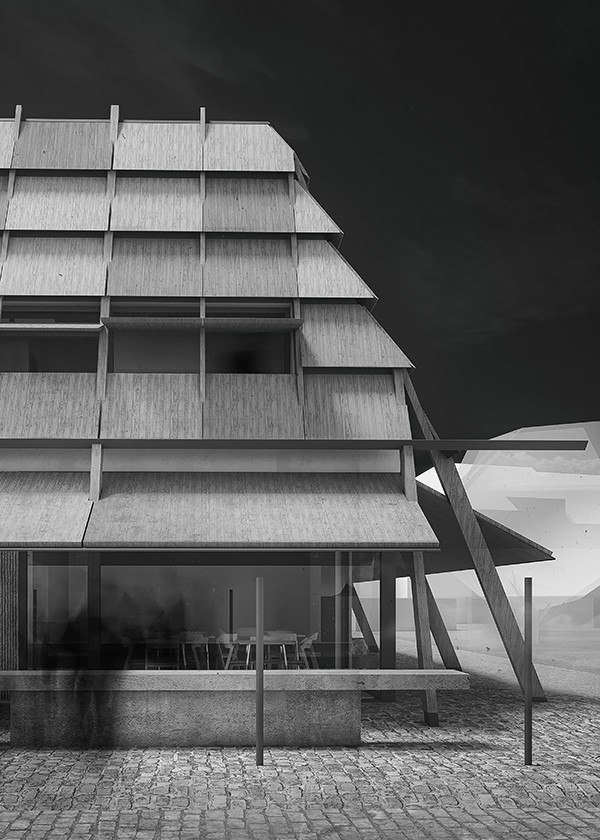
Figure 7: Exterior view of the House of Courage
The House of Courage should be a place where individuals can form intellectual revolutions, be unafraid to speak out, and where the possibility of a parallel culture [22] is articulated and discussed. Change is a messy and difficult process, but one that needs to happen from time to time, which is why the House of Courage should become the amplifier of society and a place to come together and grow. It needs to become a place that nurtures fearlessness and intellectual confrontation of the difficult because that is the only way we as a society can grow and mature.
We the authors do realize that it is impossible to escape the layers of the present time. Our intent is to look for conceptual justification for various architectural manipulations and their true nature, which does not speak of beauty per se but represents our vision of authenticity and lasting values.
©Reinis Saliņš, Igors Malovickis, Autumn 2020 – Spring 2021
Endnotes
1. Žanis Lipke rescued over 50 Jews during the Nazi occupation of Rīga from 1941 to 1944; up to 12 people could simultaneously hide in his household in Ķīpsala.
2. The Knowledge Mile is a cluster of education infrastructure on the left bank of Riga, consisting of multiple universities, institutions and cultural establishments.
3. Pallasmaa, J., 1996, The Eyes of the Skin: Architecture and the Senses, 3rd edition, Hoboken: John Wiley & Sons, 2012, p. 56.
4. Zumthor, P., Lending, M., 2018, A Feeling of History, Zurich: Verlag Scheidegger and Spiess; Zumthor explained his attempts at emotional reconstruction of past events through architecture.
5. The competition programme required a space for 150 people with two additional spaces for 30 people each. Taking into account the employees, the maximum number of people present would be 220.
6. Mill, J. S., 1859, On Liberty, London: The Walter Scott Publishing Co., Ltd., 2011, p. 8.
7. Berlin, I., 1990, The Crooked Timber of Humanity: Chapters in the History of Ideas, Henry Hardy (ed.), 2nd ed., Princeton: Princeton University Press, 2013, p. 13.
8. Mill, J. S., 1859, On Liberty, London: The Walter Scott Publishing Co., Ltd., 2011, p. 30.
9. While abandoning the past and embracing the future was proclaimed in the Manifesto of Futurism, its legacy is evident with modern movements that produce countless manifestos for a better collective future.
10. The academic polarization is most noticeably present with the formation of the so-called “intellectual dark web” – an informal group of thinkers that oppose what they regard as increasingly authoritarian tendencies within progressive movements in Western countries.
11. Haidt, J., Lukianoff, G., 2015, The Coddling of the American Mind, [online] Available at: https://www.theatlantic.com/magazine/archive/2015/09/the-coddling-of-the-american-mind/399356/
12. Mill, J. S., 1859, On Liberty, London: The Walter Scott Publishing Co., Ltd., 2011, p. 33.
13. Harvey, D., 1992, The Condition of Postmodernity, Cambridge: Blackwell, p. 327.
14. “Tyranny of the New” is an essay by Adam Caruso. In this case, the essay title is used as a term to symbolize Caruso’s and our search for parallels between the ever-increasing capitalist society and newness in architecture. Caruso, A., 1998, The Tyranny of the New, Blueprint, May issue, pp. 24-25.
15. Pallasmaa, J., 1996, The Eyes of the Skin: Architecture and the Senses, 3rd edition, Hoboken: John Wiley & Sons, 2012, p. 35.
16. Harman, G., 2018, Object-Oriented Ontology: A New Theory of Everything, London: Pelican Books.
17. Pallasmaa, J., 1996, The Eyes of the Skin: Architecture and the Senses, 3rd edition, Hoboken: John Wiley & Sons, 2012, p. 67.
18. Bergson, H., 1991, Matter and Memory, New York: Zone Books, p. 21.
19. “Eyes on the street” is a term introduced by the American activist Jane Jacobs in talking about humanizing neighbourhoods, allowing more people to be out on the streets, thus making the urban space much safer.
20. Caruso, A., 2001, The Emotional City, Quaderns, No. 288, pp. 8-13.
21. Pallasmaa, J., 1996, The Eyes of the Skin: Architecture and the Senses, 3rd edition, Hoboken: John Wiley & Sons, 2012, p. 34.
22. “Parallel culture” is a term proposed by the authors of this essay. It describes a hypothetical, decentralized and ever-present parallel medium, where free dialogue and resistance to censorship or external influence are constantly ongoing.